


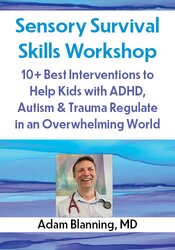
3-hour Sensory Survival Skills Workshop: 10+ Best Interventions to Help Kids with ADHD, Autism, & Trauma Regulate in an Overwhelming World
- Average Rating:
- Not yet rated
- Speaker:
- Adam Blanning, MD
- Duration:
- 3 Hours 04 Minutes
- Copyright:
-
18 Dec, 2025
- Product Code:
- POS150410
- Media Type:
- Digital Seminar
- Access:
- Never expires.

Description
- Is it behavior – or sensory overload in disguise? Uncover how hidden sensory stress fuels reactivity and anxiety.
- Why rhythm – not control – is the real key to regulation. Simple, body-based tools to restore focus and calm.
- Help kids find calm in a world that won’t slow down. Rewire stress responses through sensory-based interventions.
Today’s kids are surrounded by more stimulation – and more pressure – than ever before.
Classrooms are louder, screens brighter, and downtime harder to find.
Their brains adapt fast – but their nervous systems are showing the strain. Many struggle to focus, self-regulate, or recover from stress.
That’s where Dr. Adam Blanning comes in. A board-certified family physician and internationally respected educator, Dr. Blanning has spent over two decades teaching how sensory, immune, and emotional systems work together to shape resilience.
In this practical intervention-driven workshop, he introduces the Sensory Nutrition model – an integrative framework for helping children restore balance in a world that rarely slows down.
You’ll learn 10+ ready-to-use tools to:
- Reestablish neural balance to support sustained attention, rest, and recovery.
- Decode overwhelm using the Sensory Radius™ model to recognize anxiety and shutdown behaviors.
- Build resilience through physiology, environment, and relationship.
- Support regulation in kids with ADHD, autism, and trauma.
This isn’t another “calming tools” course.
It’s a complete sensory survival system that helps you see what’s really happening beneath the behavior – and gives you the tools to respond effectively.
You’ll leave knowing how to help children:
- Process experiences more fully.
- Recover from daily stress more quickly.
- Regulate emotions with greater confidence and ease.
Because when we help children find their rhythm, they don’t just cope better – they re-engage with curiosity, connection, and the capacity to thrive.
Purchase now!
CPD
Speaker

Adam Blanning, MD Related seminars and products
Adam Blanning, MD, is an integrative physician trained in anthroposophic medicine – a holistic approach that combines conventional medical care with developmental, sensory, and whole-person supports. He lectures nationally and internationally on child development, sensory health and integrative approaches in both medicine and education.
Dr. Blanning is the author of Raising Sound Sleepers: Helping Children Use Their Senses to Rest and Self-Soothe – recently translated into Mandarin and Spanish - and Understanding Deeper Developmental Needs: Holistic Approaches for Challenging Behaviors in Children. His work bridges research and practice, offering innovative, whole-child strategies that support resilience, regulation, and healthy development.
Speaker Disclosures:
Financial: Dr. Adam Blanning maintains a private medical practice and serves as Co-leader of the Medical Section at the Goetheanum. He holds employment affiliations with the University of Colorado School of Medicine and the Physicians’ Association for Anthroposophic Medicine. Additionally, Dr. Blanning receives royalties as a published author and receives speaking honoraria from PESI, Inc. He has no relevant financial relationships with ineligible organizations.
Non-financial: Dr. Blanning serves as a board member for both the International Federation of Anthroposophic Medical Associations and the Physicians’ Association for Anthroposophic Medicine.
Additional Info
Access for Self-Study (Non-Interactive)Access never expires for this product.
For a more detailed outline that includes times or durations of time, if needed, please contact cepesi@pesi.com.
Objectives
- Examine the concept of sensory nutrition and its clinical relevance for children with ADHD, autism, and trauma.
- Utilize the three-fold physiological framework and the sensory radius model to guide interventions that reduce anxiety and overwhelm.
- Choose sensory-based interventions that promote regulation, resilience, and engagement in children.
Outline
Part 1: From Overload to Engagement
- Why “outside-in” approaches in education and medicine fall short – and what’s missing
- The surprising cost of transactional care – and how genuine connection restores capacity
- Help kids manage the information avalanche without losing focus or joy
- Sensory support: the often-overlooked foundation for attention, regulation, and learning
Part 2: Build the Foundations of Regulation
- Two silent disruptors shaping how children grow, learn, and relate
- How sensory processing, immune health, and screen use are more intertwined than we think
- Why rhythms, routines, and patterns are biological antidotes to chaos – and the science behind them
- How outer experiences become inner habits that wire emotional balance
- Heart rate variability: a measurable window into resilience and recovery
- Rest isn’t a luxury – it’s a biological requirement for repair, balance, and growth
Part 3: Practical Tools for a Sensory-Saturated World
- How much is too much? Spotting when children cross the threshold from stimulation to overwhelm
- Use the Sensory Radius™ model to decode anxiety and identify hidden stress patterns
- Expand “sensory support” beyond fidgets and textures – into relationships, routines, and emotional tone
- What drives decision fatigue (for kids and adults) – and how to reverse it
- Strategies to help highly sensitive children thrive in a world that rarely slows down
Target Audience
- Psychologists
- Counsellors
- Physicians
- Social Workers
- Nurses
- Medical Providers
- Teachers
- And others who regularly interact with children
Reviews
Satisfaction Guarantee
Your satisfaction is our goal and our guarantee. Concerns should be addressed to info@pesi.co.uk or call 01235847393.
Please wait ...