


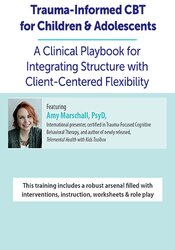
Trauma-Informed CBT for Children & Adolescents: A Clinical Playbook for Integrating Structure with Client-Centered Flexibility
- Average Rating:
- Not yet rated
- Speaker:
- Amy Marschall, PsyD
- Duration:
- 6 Hours
- Copyright:
-
16 Jun, 2025
- Product Code:
- POS058764
- Media Type:
- Digital Seminar
- Access:
- Never expires.

Description
Sometimes we struggle to balance individual kids’ needs with implementing evidence based care.
We know evidence-based treatment is an important goal, but statistics and research only go so far if the intervention isn’t the right fit for the child in the room.
Part of the experience of trauma is a sense of loss of control and disempowerment. Traumatized young clients need an active hand in their treatment, and as therapists we must foster this while implementing evidence-based care.
Dr. Amy Marschall, psychologist certified in TF-CBT and expert in evidence-based care for children and adolescents, will teach you how to balance the structure of CBT and the flexibility of a trauma-informed approach, in a way that meets each child’s unique needs.
In this one-day event, you’ll learn to:
- Integrate effective CBT techniques with a trauma-informed approach
- Adapt your approach when you feel “stuck” in treatment
- Gain confidence treating children with histories of trauma
- Choose from a robust arsenal of techniques and tricks that are useful in-the moment
- Reduce trauma-related symptoms: hypervigilance, rumination, people pleasing, dissociation, aggression, and more
- Teach kids concrete therapeutic skills while staying attuned to their trauma related needs
- Empower kids to take an active role in their treatment!
Don’t miss this opportunity to create your go-to trauma-informed playbook...
Purchase today!
CPD
Speaker

Amy Marschall, PsyD Related seminars and products
Sioux Falls Psychological Services
Amy Marschall, PsyD, is a licensed clinical psychologist in South Dakota, working primarily with children and adolescents. She is trained in trauma-informed care as well as cognitive behavioral therapy, and in 2017 became certified in trauma-focused cognitive behavioral therapy. In her clinical practice, Dr. Marschall works with survivors of abuse, families in the foster care system, children with incarcerated parents, clients dealing with high-conflict divorce or separation, and those growing up with other chronic stressors and traumas.
Dr. Marschall was diagnosed in adulthood as AuDHD (Autistic and ADHD), which informs her deeply empathetic and lived understanding of neurodivergence.
She is also the author of three professional resources: A Clinician’s Guide to Supporting Autistic Clients, Telemental Health with Kids Toolbox, and Telemental Health with Kids Toolbox, Volume 2. These publications reflect her commitment to providing accessible, neurodiversity-affirming, and trauma-informed tools for clinicians working with children and adolescents in both in-person and virtual settings.
Speaker Disclosures:
Financial: Amy Marschall is the founder of Resiliency Mental Health and has employment relationships with Prescott College, ADDitude Magazine, RMH Therapy, ADHD Online, Prosper Health, AuDHD Therapists, A Change for Better, and A Change for Better Fund. She receives royalties as a published author. Amy Marschall receives a speaking honorarium, recording, and book royalties from PESI, Inc. She has no relevant financial relationships with ineligible organizations.
Non-financial: Amy Marschall is a blogger with Resiliency Mental Health, Psychology Today, DotDash Meridith, and Everyday Health.
Additional Info
Access for Self-Study (Non-Interactive)Access never expires for this product.
For a more detailed outline that includes times or durations of time, if needed, please contact cepesi@pesi.com.
Objectives
- Integrate a trauma-informed approach to assessment, treatment planning, and sessions.
- Employ a collaborative approach to treatment planning, balancing relevant, specific, and time-measurable goals with each client’s articulated goals for their care.
- Modify therapeutic interventions based on client feedback of their unique needs, preferences, and history.
- Utilize trauma-informed cognitive behavioral interventions, including mindfulness activities, breathing exercises, visualizations, metacognition, and psychoeducation to improve function in daily activities.
- Apply evidence-based cognitive-behavioral techniques while teaching clients to identify what does or does not work for them about each technique, and adjust interventions appropriately in light of client feedback.
- Assess behavioral issues from a trauma-informed perspective, with an emphasis on identifying and addressing underlying needs rather than consequences or punishments for problem behaviors, and educate parents on how to implement this approach outside of sessions.
Outline
What Trauma Looks Like in Children & Adolescence- Adverse Childhood Experiences
- Growing up During COVID: A New Stressor
- Preverbal Trauma
- Trauma-Related Emotional and Behavioral Issues
- Developmental trauma interview; ACEs score; Trauma Symptom Checklist
- Assessment is not finite; how to continually assess client safety and therapeutic needs
- Integrating behavioral and emotional goals
- What does it mean to feel “better”?
- Actively engaging kids with a child-centered approach
- Balancing the structure of CBT with flexibility/nuance of a trauma-informed lens
- Integrating concrete skill-building into trauma processing work
- Getting to the root cause of each child’s unique trauma needs
- Preparing clients for trauma work
- Psychoeducation: deciding what information is helpful and how to present it
- Identifying the child’s level of anxiety/physiological arousal
- Teaching children the language around trauma
- Affective Monitoring
- When feelings are happening – press pause/go with the flow
- Noticing when emotions start to get bigger – feelings thermometer/feelings spectrum/volcano
- Mindfulness and body awareness
- Metacognition –
- Noticing thoughts as they come – watching the clouds/radio station
- Emotional reaction to those thoughts – naming feelings/emoji feelings
- Thought stopping activities
- Narrative therapy
- With specific trauma memories – writing vs dictating poem/children’s book/ narrative story
- Without specific memories - exploring when they learned about the trauma/ exploring feelings related to the knowledge of the trauma
- Relaxation Techniques that children enjoy
- Mindful bowling/juggling
- Guided safe place visualization
- Body scan
- Muscle relaxation
- Stong like a tree
- Art therapy
- Music
- The art of getting caregiver buy-in for participation in treatment
- Balancing honoring the client’s needs and requests with evidence-based practice and treatment goals created by guardians
- Sometimes developmental trauma needs to be re-processed as the child gets older
- Determining/Discerning how much treatment is “enough” for the child’s developmental age/
- stage
- Cultural diversity considerations for trauma work
- Limitations of the research and potential risks
Target Audience
- Psychologists
- Social Workers
- Counsellors
- Marriage & Family Therapists
- Speech-Language Pathologists
- Occupational Therapists
- School Administrators
- Physicians
- Teachers/School-Based Personnel
Reviews
Satisfaction Guarantee
Your satisfaction is our goal and our guarantee. Concerns should be addressed to info@pesi.co.uk or call 01235847393.
Please wait ...