


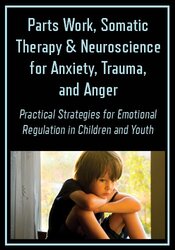
Parts Work, Somatic Therapy & Neuroscience for Anxiety, Trauma, and Anger
Practical Strategies for Emotional Regulation in Children and Youth
- Average Rating:
- 1
- Speaker:
- Leonie Stewart
- Duration:
- 6 Hours 40 Minutes
- Copyright:
-
18 Jan, 2024
- Product Code:
- AUD022317
- Media Type:
- Digital Seminar
- Access:
- Never expires.

Description
This is a unique program that offers foundational information about stress, wellbeing and mindfulness as well as lots of practical exercises. These life skills for youth will build and enhance inner resources and the ability to connect and care for themselves and others. You’ll learn to help young people befriend their ‘Big Wise Self’ – and how to get bigger than what’s bothering them – a lifechanging Parts theory technique not taught in general mindfulness courses.
Together we explore how young people can reach their unique potential, building resilience and confidence and skills for life.
One of the biggest challenges, for all of us, is to cope with the different types of stress we encounter in our lives. In a more complex, rapidly changing world, building resilience has become increasingly important.
It’s key to working and playing more effectively and creating strong relationships of hope and possibility throughout our life. Teaching these skills early and systematically in life is extremely beneficial.
Just imagine if every young person knew what it felt like to be in their BEST Self and knew how to settle the part of them that was angry or disruptive or withdrawn or just rude. This would mean they could deliberately step into their BEST self and speak and act from the BEST of themselves.
If they could do that, they would stop being disengaged and would be able to engage in their learning. And the bonus more connected quality relationships.
This program is designed to teach a suite of “life skills” that will help the young people in your care navigate their lives. This program is for everyone too. And not just for young people already flagged as having issues. Some young people do have more challenges. However, let’s face it, no-one gets through life with no bumpy bits, and everyone needs ways to settle themselves (and others) when those bumpy bits trip us up.
Complete with practical tips, demonstrations, worksheets and resources, this program can be used over and over.
CPD
Objectives
- Explore stress and ‘lid-flipping’ in young people.
- Creating age-appropriate internal safety and wellbeing
- Unfolding and guiding the young person into their ‘Big or Wise Self”
- Unpack Eugene Gendlin’s ‘Focusing’ techniques and their application to young people.
- Develop ‘Mindfulness’, ‘Focusing’ and ‘Felt Sensing’ skills.
- Refine the ‘Clearing a Space’ skill.
- Define an age-specific and easily applied version of Parts Theory to settle triggers.
- Develop ways to talk about the brain and body with easy-to-understand neuroscience language.
- Using the ‘Big Self’ to create health boundaries and effective communication.
Outline
Understanding their inner world
- Understanding threats, triggers and stress
- Giving a voice to neuroscience, parts and lid-flipping
- Brain plasticity as opportunity for strength and direction
- Facing and managing the inner critic
- Recognising stress, triggers reactions
Empowering young people
- Regulation, relaxation, and self-compassion as wellbeing essentials
- Identifying and befriending the ‘Big’ or ‘Wiser’ Self
- Resilience as an accessible hallmark of the ‘Big Self’
- Clarifying values and virtues
- Intentional confidence and self -esteem
Resources and Life Skills
- Mindfulness as practical and not a ‘far-out’ concept
- Developing perspective on what causes stress, what ‘bugs’ young people
- Defining and using healthy boundaries
- Demystifying ‘Focusing and ‘Felt-Sensing’ as accessible personal skills for young people
- Love as a foundation for inner and outer life
What is Stress? (flip our lid)
What is well being?
Gratitude Self compassion – Peaceful place. Your team
What is Mindfulness?
Difference between Mindfulness and Focusing
How to Change
Parts theory
Inner critic and strategies
Concept of your Big SELF or Big YOU
Unfold WAS – left brain/right brain
Marrying Focusing, Parts Theory and right/left brain neuroscience
Intro to Focusing and felt sensing with experiential demo
Introduction to Focusing - Gendlin’s philosophy and the 6 steps
Clearing a space (with demo)
Using the ‘Big Self’ and getting bigger than what is bothering you (with demo)
Creating a protective boundary 9with demo)
Effective communication – Feedback Wheel, Time out
Reviews
| 5 |
|
| 4 |
|
| 3 |
|
| 2 |
|
| 1 |
|
Overall: 4
Total Reviews: 1
Satisfaction Guarantee
Your satisfaction is our goal and our guarantee. Concerns should be addressed to info@pesi.co.uk or call 01235847393.
Please wait ...