


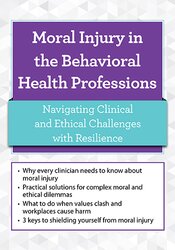
Moral Injury in the Behavioral Health Professions
Navigating Clinical and Ethical Challenges with Resilience
- Average Rating:
- Not yet rated
- Speaker:
- Frederic G. Reamer, PhD
- Duration:
- 6 Hours 27 Minutes
- Copyright:
-
06 Mar, 2024
- Product Code:
- POS059612
- Media Type:
- Digital Seminar
- Access:
- Never expires.

Description
- The signs and symptoms of moral injury and moral distress in the behavioral health professions
- How to demystify whistleblowing for ethical alignment and strong professional advocacy
- Strategies to buffer against vicarious trauma and leverage post-traumatic growth
- Potential consequences of moral injury, including harm to clients or the risk of malpractice claims
- Strategies to develop and maintain moral courage in the face of ethical challenges
CPD
Speaker

Frederic G. Reamer, PhD Related seminars and products
School of Social Work, Rhode Island College
Frederic G. Reamer, PhD, Professor Emeritus has taught in the graduate program of the school of social work, Rhode Island College, Providence, Rhode Island for 40 years. Dr. Reamer received his PhD from the University of Chicago and has served as a social worker in correctional and mental health settings. He chaired the national task force that wrote the National Association of Social Workers Code of Ethics and served on the task force that added technology standards to the code. Dr. Reamer lectures both nationally and internationally on the subjects of professional ethics, professional malpractice and liability, and documentation. In addition to ethics, his research and a teaching have addressed a wide range of human service issues, including mental health, health care, criminal justice, and public welfare. Dr. Reamer has conducted extensive research on professional ethics and has been involved in several national research projects sponsored by The Hastings Center, Carnegie Corporation, Haas Foundation, and Center for Bioethics of the University of Pennsylvania. Dr. Reamer has been an expert witness and formal ethics consultant in more than 130 litigation and licensing board cases throughout the United States. He is the author of many books and other publications on ethical standards in behavioral health, risk management, and documentation.
Speaker Disclosures:
Financial: Frederic Reamer receives royalties as a published author. Frederic Reamer receives a speaking honorarium and recording royalties from PESI, Inc. He has no relevant financial relationships with ineligible organizations.
Non-financial: Frederic Reamer serves as an advisory board member of Ocean State Stories, Pell Center, Salve Regina University and an advisory editor for the Encyclopedia of Social Work Online. He is a member of NASW Code of Ethics Revision Task Force, National Association of Social Workers, and the Association of Paroling Authorities International.

Additional Info
Access for Self-Study (Non-Interactive)Access never expires for this product.
For a more detailed outline that includes times or durations of time, if needed, please contact cepesi@pesi.com
Objectives
- Identify the signs and symptoms of moral injury and moral distress in the behavioral health professions.
- Determine the causes of moral injury.
- Identify ethical standards related to moral injury.
- Evaluate the relationship between moral injury and secondary trauma–related constructs (including vicarious traumatization, compassion fatigue, compassion satisfaction, and posttraumatic growth) within professional practice contexts.
- Utilize strategies to prevent and respond to moral injury.
- Appraise ethical considerations and professional boundaries related to clinical, organizational, community, and policy advocacy.
Outline
The nature of moral injury and moral distress
- The danger of perpetrating harm
- Witnessing and learning about harm
- Failing to prevent harm
- Patterns of moral injury
- Signs and symptoms of moral injury
- The role of demoralization
- Research risks and limitations
- Case examples:
- Clinician who witnesses harm inflicted on clients
- Clinician who fails to prevent harm caused to clients
Causes of moral injury in the behavioral health professions
- Professional burnout
- Professional impairment
- Workplace conditions
- Social conditions and policies
- Ethical dilemmas
- Case examples:
- Workplace conditions that cause harm
- Clinician who experiences burnout
Consequences of moral injury: Secondary trauma, compassion satisfaction, and moral repair
- Secondary trauma
- Vicarious traumatization
- Compassion fatigue
- Vicarious resilience, posttraumatic growth, and compassion satisfaction
- Moral repair and apology
- Restorative justice: Addressing harm to individuals and communities
- Transitional justice: Organizational and institutional accountability
- Case examples: A clinician who experiences secondary trauma and vicarious traumatization
Professionals’ ethical responsibilities: Moral choices and whistleblowing
- The nature of whistleblowing: Ethical standards
- Ethics violations that cause moral injury
- Practitioner impairment
- Disclosure of moral injury and defamation risks
- Standards of care
- Case examples:
- Clinician who considers blowing the whistle on misconduct
- A clinician who violates ethical standards
Prevent moral injury: The role of prevention protocols, advocacy, and moral courage
- Organizational change
- Community advocacy
- Policy advocacy
- Alternative dispute resolution
- Moral courage to expose and address moral injury
- Case examples: Clinicians engaging in change and advocacy
Ethical standards as they relate to self-care
- Key concepts
- Codes of ethics and self-care standards
- Barriers to self-care
- Reflective practice
- Case examples:
- Clinician’s efforts to engage in ethicsinformed self-care
- Clinician who engages in reflective practice
Target Audience
- Counsellors
- Social Workers
- Psychotherapists
- Psychologists
- Addiction Counsellors
- Therapists
- Marriage & Family Therapists
- Case Managers
- Nurses
- Physicians
- Other Mental Health Professionals
Reviews
Satisfaction Guarantee
Your satisfaction is our goal and our guarantee. Concerns should be addressed to info@pesi.co.uk or call 01235847393.
Please wait ...