


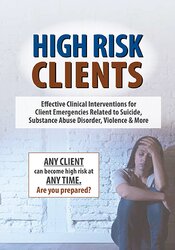
High Risk Clients: Effective Clinical Interventions for Client Emergencies Related to Suicide, Substance Use Disorder, Violence & More
- Average Rating:
- 10
- Speaker:
- Paul Brasler, LCSW, CAIMHP
- Duration:
- 6 Hours 24 Minutes
- Copyright:
-
04 Nov, 2025
- Product Code:
- POS049335
- Media Type:
- Digital Seminar
- Access:
- Never expires.

Description
Crises are never scheduled, convenient or easy. But they do happen and you will face them. Clients at risk for crisis often present with so many symptoms and issues, it’s hard to know where to start. Many clinicians, anxious about how to proceed, often miss or avoid asking the right questions to effectively intervene and keep clients (and themselves) safe.
As a clinician, have you ever felt:
- Worried about the safety of your clients, even feared for their lives, but felt unprepared to handle the situation?
- Unsafe in the clinical environment, or unsure of how to handle situations where someone connected to your client might be in danger?
- Caught off guard when you’re wrapping up a session and a client discloses suicidal thoughts?
- Unsure if a client was using drugs, and ill equipped to identify the signs and symptoms of drug abuse?
- Concerned that you’re doing more harm than good for traumatized clients, despite your best intentions?
Watch Paul Brasler, LCSW, as he navigates you through five of the most difficult scenarios in mental health today. Through real-life examples and live role plays, Paul will share the concrete strategies that he’s used over the last two decades to safely and effectively intervene in the challenging, urgent, and sometimes alarming situations that mental health professionals face.
Full of practical tools and tips, this live webcast will teach you to how to make crises situations more manageable, overcome your worries, and improve your readiness to handle mental health emergencies related to suicide, violence, substance abuse, trauma, and medical issues.
Better still, instruction on professional liability management techniques, tips for documentation, and detailed reproducible assessment forms will have you feeling confident that you can focus on doing what’s best for your clients without fear of litigation. And, Paul’s guidance is applicable to your work regardless of your setting or clinical background.
Leave this seminar equipped to help your most vulnerable clients with the real-life skills and knowledge they don’t teach in graduate school!
CPD
Speaker

Paul Brasler, LCSW, CAIMHP Related seminars and products
Paul Brasler, LCSW, CAIMHP, became a licensed clinical social worker in 2002. Paul is the coordinator for the Chesterfield County (Virginia) Employee Behavioral Health Program, through which he and his team provide clinical services to first responders and human services personnel. He has extensive experience working with people in crisis and people living with substance use disorders, including adolescent residential treatment, community mental health settings, hospital emergency departments, juvenile drug court, and private practice.
Paul has been a national presenter (through PESI) since 2016, and he has presented classes across the country on mental health emergencies, high-risk clients, resiliency, and a certification course for clinicians working with people with substance use disorders. He has written three books: The Clinician’s Guide to Suicide Management, PESI Publishing, 2025; The Clinician’s Guide to Substance Use Disorder, PESI Publishing, 2022; and High-Risk Clients, PESI Publishing, 2019. Paul lives in Richmond, Virginia, with his beautiful wife, three sons, cowardly dog, and two dwarf rabbits who are quietly plotting to destroy the world.
Speaker Disclosures:
Financial: Paul Brasler maintains a private practice and has an employment relationship with Chesterfield County. He receives a speaking honorarium, recording, and book royalties from Psychotherapy Networker and PESI, Inc. He has no relevant financial relationships with ineligible organizations.
Non-financial: Paul Brasler has no relevant non-financial relationships.
Additional Info
Access for Self-Study (Non-Interactive)Access never expires for this product.
Objectives
- Complete a comprehensive mental health assessment that encompasses a multitude of clinical concerns including mental status, lethality, substance abuse and trauma.
- Determine when to hospitalize clients struggling with suicidal ideation, substance abuse, medical concerns or violent urges and develop protocols for doing so.
- Provide coping strategies and support to clients presenting with suicidal ideation by helping to create a safety plan in session.
- Assess for risk of client violence towards others and develop strategies to safely intervene as well as effectively carry out the clinician’s duty to protect.
- Determine signs and symptoms of intoxication, withdrawal, or overdose in clients and develop plans for effective intervention.
- Differentiate between medical and psychological presenting concerns as they relate to case conceptualization.
Outline
Client Assessment: Ask the Right Questions- Conduct comprehensive assessments
- Strategies for eliciting the right information
- What to ask yourself as you watch the client
- Can the client provide informed content?
- Limitations of the research & potential risks
- Who is most at risk?
- Implicit & explicit expressions of suicidal ideation & intent
- Lethality assessment to protect client & clinician
- Self-injurious behavior & suicidal ideation
- How to conduct a suicide assessment
- Safety planning for clients with suicidal ideation
- When to hospitalize
- Voluntary vs. involuntary hospitalization
- When clients are not admitted to the hospital
- Dealing with our fears: Clinicians’ safety
- When the clinician is the target
- When others are the target
- De-escalation techniques
- Preventative planning
- When to call 911
- The hospitalization process
- Duty to Protect (formerly Duty to Warn)
- Signs of intoxication
- Imminent risk: Signs & symptoms of overdose
- Identify withdrawal syndromes
- Treatment planning
- Drug basics that clinicians should know
- Need-to-know street names of common drugs
- When and how to refer to a higher level of care
- What could kill the client first?
- Medical emergencies that present with psychological symptoms
- Signs & symptoms of a medical emergency
- Recognize trauma in clients
- Dangers of misdiagnosis & improper treatment
- Strategies for trauma-informed care
- Protect your license with documentation
- Debriefing & supervision
- Address vicarious trauma
- Mitigate compassion fatigue
Target Audience
- Counsellors
- Social Workers
- Psychologists
- Case Managers
- Addiction Counsellors
- Marriage & Family Therapists
- Psychiatrists
- Nurses
- Nurse Practitioners
- Other Mental Health Providers
- Paramedics
- Police Officers
- Probation/Parole Officers
- Art Therapists
Reviews
| 5 |
|
| 4 |
|
| 3 |
|
| 2 |
|
| 1 |
|
Overall: 4.8
Total Reviews: 10
Satisfaction Guarantee
Your satisfaction is our goal and our guarantee. Concerns should be addressed to info@pesi.co.uk or call 01235847393.
Please wait ...