


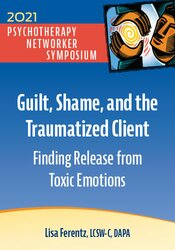
Guilt, Shame, and the Traumatized Client: Finding Release from Toxic Emotions
- Average Rating:
- 167
- Speaker:
- Lisa Ferentz, LCSW-C, DAPA
- Duration:
- 3 Hours 59 Minutes
- Format:
- Audio and Video
- Copyright:
-
18 Mar, 2021
- Product Code:
- NOS096100
- Media Type:
- Digital Seminar
- Access:
- Never expires.

Description
Although trauma can affect clients’ inner lives in countless ways, most survivors grapple with deep-seated feelings of guilt and shame. Until these powerful and debilitating emotions are specifically addressed, it’s difficult for clients to fully heal. In this recording, learn how to compassionately help clients understand the root causes of shame and guilt, and offer creative strategies for releasing themselves from the grip of these toxic emotions. You’ll explore:
- The difference between guilt and shame, and why shame is so difficult to resolve
- The specific dynamics of trauma and early childhood coping strategies that promote and sustain shame
- How secondary gain and “protective parts” affect clients’ willingness to let go of shame
- How to cognitively, somatically, and creatively enhance the two antidotes to shame: self-compassion and curiosity
CPD
Speaker

Lisa Ferentz, LCSW-C, DAPA Related seminars and products
Lisa Ferentz, LCSW-C, DAPA, is a recognized expert in the strengths-based, de-pathologized treatment of trauma and has been in private practice for over 40 years. She has been an adjunct faculty member at several universities, and is the founder of The Ferentz Institute, now in its seventeenth year of providing continuing education to mental health professionals and graduating several thousand clinicians from her two certificate programs in advanced trauma treatment. In 2009 she was voted the “Social Worker of the Year” by the Maryland Society for Clinical Social Work. She is the author of Treating Self-Destructive Behaviors in Trauma Survivors: A Clinician’s Guide, now in its second edition, Letting Go of Self-Destructive Behaviors: A Workbook of Hope and Healing and Finding Your Ruby Slippers: Transformative Life Lessons from the Therapist’s Couch.
Speaker Disclosures:
Financial: Lisa Ferentz maintains a private practice and is the Founder and President of the Ferentz Institute. She receives royalties as a published author. Lisa Ferentz receives a speaking honorarium and product royalties from Psychotherapy Networker and PESI, Inc. She has no relevant financial relationships with ineligible organizations.
Non-financial: Lisa Ferentz is a member of the National Association of Social Workers and the American Psychotherapy Association.
Objectives
- Determine the difference between guilt and shame for clients, and why shame is so difficult to resolve.
- Determine the specific dynamics of trauma and early childhood coping strategies that promote and sustain shame.
- Evaluate how secondary gain and “protective parts” impact clients’ willingness to let go of shame.
- Assess the role the therapeutic relationship plays in helping clients process shame.
- Determine how to cognitively, somatically, and creatively enhance clients’ self-compassion and curiosity to help them let go of shame.
Outline
- Explain the difference between guilt and shame for clients, and why shame is so difficult to resolve.
- Guilt as a byproduct of an interpersonal exchange or a behavioural choice versus core feelings of worthlessness or being inherently damaged or “bad.”
- Apologizing and making amends versus fundamentally changing one’s sense of self
- Determine the specific dynamics of trauma and early childhood coping strategies that promote and sustain shame.
- Witnessing abuse, survivor guilt, the shame of keeping silent, the shame of “participating” in sexual trauma, misunderstanding the freeze response
- Taking ownership of trauma to preserve familial loyalty
- Explore how secondary gain and “protective parts” impact clients’ willingness to let go of shame.
- Reducing expectations, the risk of failing or disappointing others
- Rationalizing self-destructive and addictive behaviours
- Inner critics using shame to “motivate” and prevent abandonment
- Consider the role the therapeutic relationship plays in helping clients process shame.
- Modelling self-compassion and positive self-talk
- Using psychoeducation and curiosity to release clients from self-blame
- The healing impact of attunement
- Describe how to cognitively, somatically, and creatively enhance clients’ self-compassion and curiosity to help them let go of shame.
- Using the “crossroad of a thought” and “double standard” cognitive strategies to let go of shame
- Using “remembered resource,” sand tray work, art strategies, two-handed writing, and spirituality to creatively enhance compassion
- Using “focusing,” body map, and somatic resourcing to understand the somatic impact of shame and bring comfort to the debilitating emotion
Target Audience
- Counsellors
- Social Workers
- Psychologists
- Psychotherapists
- Therapists
- Marriage & Family Therapists
- Addiction Counsellors
- Case Managers
- Physicians
- Nurses
- Other Mental Health Professionals
Reviews
| 5 |
|
| 4 |
|
| 3 |
|
| 2 |
|
| 1 |
|
Overall: 4.9
Total Reviews: 167
Satisfaction Guarantee
Your satisfaction is our goal and our guarantee. Concerns should be addressed to info@pesi.co.uk or call 01235847393.
Please wait ...