


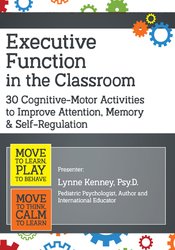
Executive Function in the Classroom: 30 Cognitive-Motor Activities to Improve Attention, Memory & Self Regulation
30 Cognitive-Motor Activities to Improve Attention, Memory & Self Regulation
- Average Rating:
- 5
- Speaker:
- Lynne Kenney, PsyD
- Duration:
- 5 Hours 59 Minutes
- Format:
- Audio and Video
- Copyright:
-
14 Nov, 2019
- Product Code:
- POS053230
- Media Type:
- Digital Seminar - Also available: Digital Seminar
- Access:
- Never expires.

Description
Teaching students how they think, learn and behave empowers them to play an active role in their own learning. When children with ADHD, anxiety, learning differences, oppositional tendencies and disinterest in school are taught how to be “Cognitive Scientists” coaching their own brains to plan, prioritize, attend and remember, they become more invested in school and motivated to learn.
Taking the mystery out of executive functions by showing students how to learn more efficiently while calming their defensive brains leads to better concentration, improved attention, higher academic achievement and competent social-emotional skills.
In this recording, Lynne Kenney, Psy.D., pediatric psychologist, author and international educator, will teach you how to integrate the newest research in neuroscience, kinesiology and education for kids to learn more efficiently.
You will discover over 30 developmentally progressive cognitive-exercises, worksheets and activities to enliven your classroom.
Learn how to improve cognition, enhance learning and empower children to be better thinkers with motor movement, sequencing, attending, self-regulation and memory activities.
CPD
This online program is worth 6.0 hours CPD.
Handouts
| File type | File name | Number of pages | |
|---|---|---|---|
| Manual - Executive Function in the Classroom (12.49 MB) | 131 Pages | Available after Purchase |
Speaker

Lynne Kenney, PsyD Related seminars and products
Move2Think, LLC
Dr. Lynne Kenney is the nation’s leading pediatric psychologist in the development of classroom cognitive-physical activity programs for students grades K-8. She develops curriculum, programming, and activities to improve children’s cognition through coordinative cognitive-motor movement, executive function skill building strategies, and social-emotional learning. Her current educational program is CogniMoves®, a classroom cognitive-motor movement program, co-developed with Benjamin S. Bunney, MD, Former Chairman Department of Psychiatry at Yale University. CogniMoves® is designed to strengthen executive function skills in K-3 students.
Dr. Kenney is a pediatric psychologist on the language & cognition team at Wellington-Alexander Center for the Treatment of Dyslexia, Scottsdale, Arizona. She has advanced fellowship training in forensic psychology and developmental pediatric psychology from Massachusetts General Hospital/Harvard Medical School and Harbor-UCLA/UCLA Medical School. As an international educator, researcher, and author, she is dedicated to improving the trajectory of children’s learning, particularly in high-need, under-resourced communities. Dr. Kenney’s books include Brain Primers, 2020 (Kuczala & Kenney); 70 Play Activities for Better thinking, Self-Regulation, Learning and Behavior (Kenney & Comizio, 2016); the Social-Emotional Literacy program, Bloom Your Room™; Musical Thinking™, and Bloom: 50 Things To Say, Think and Do with Anxious, Angry and Over-the-Top Kids (Kenney & Young, 2015). Her most recent endeavor is Cognitivities™, an original collection of portable mats that combine music, art, and movement developed with Fit and Fun Playscapes. Launched in 2024, this is the first Roll-Out Activities® mat of its kind, helping children with cognitive skills, executive function, and self-regulation in a calming and engaging way. In development, FlowMoves™ cognitive-motor movement cards for high-need communities and families to support co-regulation and self-regulation.
Since 1985, Dr. Kenney has worked as an educator in community services with national organizations including the Neurological Health Foundation, Head Start, Understood.org, HandsOn Phoenix, SparkPE, the First Nations in Canada, and Points of Light (Generation On). Dr. Kenney values working with Title I Schools.
Speaker Disclosures:
Financial: Dr. Lynne Kenney is the creator of CogniSuite & The Kinetic Classroom and the co-creator of 5n45. She is the co-owner of Move2Learn, LLC and has an employment relationship with Wellington-Alexander Center for the Treatment of Dyslexia and receives compensation as a consultant. Dr. Kenney receives royalties as a published author. She receives a speaking honorarium and recording royalties from PESI, Inc. She has no relevant financial relationships with ineligible organizations.
Non-financial: Dr. Lynne Kenney is Play Math Ambassador.
Alternate Options
Objectives
- Implement research-based activities educators, teachers and school psychologists can use to improve thinking, self-regulation and behavior.
- Characterize the relationship between cognition and motor movement.
- Practice bringing physical activity back to the classroom with neurocognitive activities.
- Demonstrate how students calm their defensive brains leading to better concentration, improved attention and competent social-emotional skills.
- Evaluate the integration of computer-based cognitive skills training and motor movement activities
- Choose how to enhance collaboration and cooperation in your classroom by teaching children applied neuroscience research.
Outline
What You Need to Know about Movement and Cognition
- Explore new neuroscience + kinesiology + education research
- Teach children how the brain is built – manage their 3-part brains
- Define & teach executive functions to children
- Embodied cognition – learning is a whole-body experience
- Bring daily physical activity into the classroom
Current Research on the Role of Movement in Learning
- Physical activity improves health and academic achievement
- Types of exercise that improve executive function
- How to Implement a movement schedule
- Using collaboration and student creativity to improve behaviour
Activities, Tools and Strategies
Alerting, Attending and Energizing
- March Match
- Find The Pulse
- Clap & Tap
- I’m a Star
- Over the Line in 4/4 time
- The Little Jane Fonda
- Wave Jump
- Switch Tasks
- Clap, Snap, Tap
- Rhythm and Rhyme
- Body Percussion
- Pretend Drums
Self-Regulation
- The difference between self-regulation and self-control
- Task demands and perceived stress
- Stressor identification & arousal states
- Slowing down for better cognitive control
- Keeping the marshmallow in the middle
- Entrainment and Synchrony
- Entrain me (Walk & Bounce with me)
- Co-Regulation – Swing, sway, sing
- Meditation and Mindfulness
- The Music Carpet Ride
- Middle C OHM
- Head, Shoulders, Hips & Knees
- Tai Chi
- Pretend Balance Beam
- Yogivate in ACTIVATE
- Rhythm Ball
- 3, 5, 7, 9 For Calming in Time
- Mirroring with Big Ben
Attention/Memory
- The BIG 3 – attention, working memory & self-control
- Having a Ball!
- ACTIVATE
- The Secret is The Sequence
- The Parts of the Task Game
- Cognitive Conversations
- The THINK Cards
- My Attention Engine
- Play Math
Behaviour
- Anxiety, agitation and hopefulness
- What to say, think and do when children are escalating
- The power of self-talk
- Who’s Jelly Beans Am I Holding?
- The Purpose Circle
- What’s In It For Me?
- Anger and Perceived Loss
- Anger Mountain
- My Anger Manager
- I’ll Give This 10
Target Audience
- Educators
- Special Educators
- Psychologists
- School Psychologists
- Counselors
- Social Workers
- Occupational Therapists
- Speech-Language Pathologists
- Other Helping Professionals
Reviews
| 5 |
|
| 4 |
|
| 3 |
|
| 2 |
|
| 1 |
|
Overall: 5
Total Reviews: 5
Satisfaction Guarantee
Your satisfaction is our goal and our guarantee. Concerns should be addressed to info@pesi.co.uk or call 01235847393.
Please wait ...