


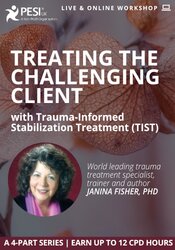
Treating the Challenging Client with Trauma-Informed Stabilization Treatment (TIST)
- Average Rating:
- 23
- Speaker:
- Janina Fisher, PhD
- Duration:
- 12 Hours 04 Minutes
- Format:
- Audio and Video
- Copyright:
-
01 Apr, 2025
- Product Code:
- PDR002147
- Media Type:
- Digital Seminar
- Access:
- Never expires.

Description
Traumatized clients can often present clinical challenges that defy the therapist’s best efforts and positive intentions, leaving us feeling ineffective or overwhelmed. TIST is an approach designed for complex trauma clients that resonates for them and speaks to the inner conflicts they experience. A trauma-informed parts model, TIST draws on ideas and techniques from Internal Family Systems, Sensorimotor Psychotherapy, and mindfulness-based therapies to transform the client relationships to their feelings, impulses, and negative beliefs. You will acquire skills that make even your most resistant and stuck clients begin to move ahead into a life beyond trauma with a new compassion for themselves.
CPD
Speaker

Janina Fisher, PhD Related seminars and products
Janina Fisher, PhD, is a licensed clinical psychologist and former instructor at The Trauma Center, a research and treatment centre founded by Bessel van der Kolk. Known as an expert on the treatment of trauma, Dr Fisher has also been treating individuals, couples and families since 1980.
She is past president of the New England Society for the Treatment of Trauma and Dissociation, an EMDR International Association Credit Provider, Assistant Educational Director of the Sensorimotor Psychotherapy Institute, and a former Instructor, Harvard Medical School. Dr Fisher lectures and teaches nationally and internationally on topics related to the integration of the neurobiological research and newer trauma treatment paradigms into traditional therapeutic modalities.
She is co-author with Pat Ogden of Sensorimotor Psychotherapy: Interventions for Attachment and Trauma (2015) and author of Healing the Fragmented Selves of Trauma Survivors: Overcoming Internal Self-Alienation (2017) and the forthcoming book, Working with the Neurobiological Legacy of Trauma (in press).
Speaker Disclosures:
Financial: Dr. Janina Fisher is an international expert and consultant on Trauma and Dissociation. She is a consultant for Khiron House Clinics and the Massachusetts Department of MH Restraint and Seclusion Initiative. Dr. Fisher receives royalties as a published author. She receives a speaking honorarium, recording royalties and book royalties from Psychotherapy Networker and PESI, Inc. Dr. Fisher has no relevant financial relationships with ineligible organizations.
Non-financial: Dr. Janina Fisher is on the advisory board for the Trauma Research Foundation. She is a patron of the Bowlby Center.
Objectives
- Articulate the neurobiological effects of traumatic experience
- Define the structural dissociation model
- Elicit client collaboration in increasing their awareness of trauma-related parts
- Implement mindfulness-based techniques to regulate parts
- Increase client ability to sustain interest and curiosity in the parts
- Develop compassionate relationships to the parts
Outline
Neurobiological effects of childhood traumatic experiences
- Dissociation and self-alienation as a survival response
- The necessity to disown emotions or needs in unsafe environments
- Introduction to TIST
The structural dissociation theory as an explanatory model
- The biological basis for understanding trauma-related parts
- Understanding parts as survival-oriented, not memory-oriented
- Helping clients connect symptoms and distressing emotions to specific parts
Beginning stages of working with TIST
- Noticing rather than reacting to the parts
- Cultivating interest and the ability to listen to parts
- Decreasing identification with parts: ‘this part wants to suicide—not me’
Inner communication and dialogue with parts
- Developing relationships with parts: Who are they? What are they worried about?
- Learning to ‘ask inside’ to invite dialogue
- Negotiating and collaborating with parts rather than trying to suppress them
Compassionate attachment and reparative experiences for trauma healing
- Overcoming the habits of rejecting and/or disowning parts
- Developing empathy for them as children who still experience the world as dangerous
- Providing reparative experiences for the parts that heal their wounds
Target Audience
- Psychologists
- Counsellors
- Social Workers
- Family Therapists
- Psychotherapists
- Other Mental Health Professionals
Reviews
| 5 |
|
| 4 |
|
| 3 |
|
| 2 |
|
| 1 |
|
Overall: 4.8
Total Reviews: 23
Satisfaction Guarantee
Your satisfaction is our goal and our guarantee. Concerns should be addressed to info@pesi.co.uk or call 01235847393.
Please wait ...