


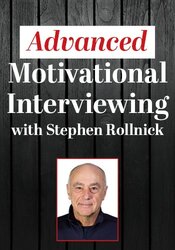
Advanced Motivational Interviewing with Stephen Rollnick
How to Use Advice and Offer Feedback that Works in Therapy
- Average Rating:
- Not yet rated
- Speakers:
- Stephen Rollnick, PhD | Orla Adams
- Duration:
- 7 Hours 19 Minutes
- Format:
- Audio and Video
- Copyright:
-
17 Jun, 2026
- Product Code:
- POS150467
- Media Type:
- Digital Seminar
- Access:
- Never expires.
Description
For decades, clinicians have been warned to avoid giving advice in therapy for fear of triggering resistance, damaging rapport, or undermining client autonomy. Yet many clients explicitly seek guidance — and when handled skillfully, feedback can become a catalyst for engagement, collaboration, and real behavioral change. It can also be seamlessly merged with motivational interviewing.
In this advanced training, Motivational Interviewing (MI) co-founder Stephen Rollnick, PhD, supported by Orla Adams, explore how the MI approach has evolved to embrace advice and feedback as essential components of the therapeutic process — when they are offered with respect, autonomy support, and collaborative spirit. Through a combination of lecture, discussion, demonstration, and applied practice, participants will learn how to integrate MI-consistent guidance into sessions focused on anxiety, depression, trauma, relationship issues, and other clinical concerns.
Participants will deepen their understanding of the nuanced language, timing, and structure that transform advice from a source of resistance into an opportunity for change. They will also gain ready-to-use scripts and strategies that increase engagement, reduce dropout, and foster sustained motivation — equipping them to meet client needs more effectively in diverse real-world contexts.
CPD
Speaker

Stephen Rollnick, PhD Related seminars and products
Author/Consultant
Private Practice
Stephen Rollnick, PhD, is on the faculty in the Department of Primary Care & Public Health at Cardiff University, Wales. He has also worked for many years as a clinical psychologist in the British National Health Service. With a background in the addiction field, his interest turned to consultations about behavior change in wider mental health & healthcare practice, where practitioners try to encourage clients to change their lifestyle and use of medication. Dr. Rollnick’s research and teaching activity is now focused on the behavior of practitioners and other topics. He has trained practitioners in many countries and continents, and has published a wide range of research papers, articles and books.
- Co-author, with William R. Miller, of key texts on Motivational Interviewing, including the recently published Motivational Interviewing: Helping People Change, 3rd Edition
- 25 years’ experience working with therapists and practitioners across the globe
- Co-founder and leading member of the international Motivational Interviewing Network of Trainers (MINT)
- Clinical expertise in addiction, panic and anxiety, HIV-AIDS, chronic illness and depression
Speaker Disclosures:
Financial: Stephen Rollnick is the co-founder of Steering Group, the Centre for Motivation & Change, and International Conference on Motivational Interviewing. He has an employment relationship with the Department of Public Health and is consultant to Ms. Kate Billingham and staff. Stephen Rollnick receives royalties as a published author. He receives a speaking honorarium and recording royalties from PESI, Inc. He has no relevant financial relationships with ineligible organizations.
Non-financial: Stephen Rollnick has no relevant non-financial relationships.



Orla Adams Related seminars and products
Biography:
Orla Adams is a member of the Motivational Interviewing Network of Trainers (MINT). Orla is an experienced trainer in motivational interviewing, providing advanced independent consultancy, one-to-one, and group training. Orla is a qualified dietitian with more than 20 years of experience in the NHS and a special interest in weight management who regularly delivers training and skills coaching to companies and teams across the UK and beyond.
Speaker Disclosures:
Financial: Orla Adams has an employment with Riverside Health Centre. She previously received an honorarium from Novo Nordisk. Orla Adams receives a speaking honorarium from PESI, Inc. She has no relevant financial relationships with ineligible organizations.
Non-financial: Orla Adams has no relevant non-financial relationships.
Additional Info
Access Period for Live WebcastFor live CE credit, you must watch the live webcast in its entirety at its scheduled time and complete the CE quiz and evaluation within one week. You will have access for 90 days after the program for review.
Webcast Schedule
Please note: There will be a lunch and two 15-minute breaks; one in the morning and one in the afternoon. Lunch and break times will be announced by the speaker and at their discretion. A more detailed schedule is available upon request.
Questions?
Visit our FAQ page at www.pesi.com/faq or contact us at www.pesi.com/info
Objectives
- Identify the core principles and spirit of Motivational Interviewing (MI), including the role of autonomy, collaboration, and evocation in clinical practice.
- Distinguish MI-consistent advice-giving from directive or persuasive approaches that may increase client resistance.
- Identify common clinician behaviors that can interfere with client engagement and motivation.
- Choose appropriate MI-consistent strategies (e.g., Ask–Offer–Ask) for introducing feedback or advice in clinical conversations.
- Apply MI communication skills to support client autonomy when discussing behavior change.
- Contrast demonstrations of poor and better client communication practices.
- Define potential risks and limitations of advice-giving in therapy, including the impact on client resistance and engagement.
- Utilize intervention strategies to manage resistance and reduce reactance in high-stakes or ambivalent clinical interactions.
Outline
- A guiding superstyle: communication styles and the place of guiding
- Overview of MI: spirit, tasks, and skills
- Advice and feedback in therapy: a common challenge
- MI & advice: distant relations or close siblings?
- Risks and limitations — research and applications
- Three key elements: your style, the relationship & the client
- Resistance re-defined
- The skills that matter
- Communication strategies to reduce resistance
- The spirit of advice-giving: helpfulness matrix, listening and the language of offering up
- Core skills overview
- Language patterns that invite collaboration
- Linking advice to intrinsic motivation and self-determination
- The importance of permission-seeking and autonomy support
- Importance & confidence scaling: tapping into client values
- Deficit detective and the fixing reflex
- How it can go wrong: five common traps
- The ASK-OFFER-ASK skills map
- A deep dive into skills — What kind of open questions? The language of choice when reflecting. Placing the feedback on the table between you.
- When it all goes wrong
- Demonstration: what does dumping advice actually look and feel like?
- Analysis and evaluation
- How do you integrate advice into routine sessions?
- Principles of good practice
- Top five questions
- Demonstration and evaluation
- How do you offer advice to someone who doesn’t seem motivated to change?
- Demonstration: a tough conversation with someone who does not want to change
- Put ASK-OFFER-ASK into action
- Analysis and evaluation
- Offering advice in sessions addressing trauma, anxiety, and depression
- Navigating ambivalence in high-stakes conversations
- Timing and pacing feedback to client readiness
- Combining MI feedback strategies with other therapeutic modalities
- Feedback in collaborative treatment planning and progress reviews
- Ethical considerations and cultural responsiveness
- Applied skills practice and feedback from peers/facilitator
- Strategies for continued skill development and supervision
Target Audience
- Counselors
- Social Workers
- Psychologists
- Case Managers
- Addiction Counselors
- Therapists
- Art Therapists
- Marriage & Family Therapists
- Physicians
- Nurses
- Other Mental Health Professionals
Reviews
Satisfaction Guarantee
Your satisfaction is our goal and our guarantee. Concerns should be addressed to info@pesi.co.uk or call 01235847393.
Please wait ...