


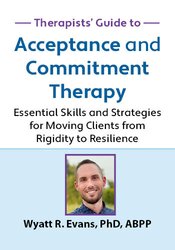
Therapists’ Guide to Acceptance and Commitment Therapy: Essential Skills and Strategies for Moving Clients from Rigidity to Resilience
- Average Rating:
- Not yet rated
- Speaker:
- Wyatt R. Evans, PhD, ABPP
- Duration:
- 6 Hours 30 Minutes
- Copyright:
-
10 Apr, 2025
- Product Code:
- POS150104
- Media Type:
- Digital Seminar
- Access:
- Never expires.

Description
As a dedicated therapist, you’re already equipped with a powerful toolkit to help your clients transform their hurtful thoughts and break free from unhelpful behaviours.
But what happens when those tools fall short or you hit a wall with your current approach?
It’s time to expand your toolkit with Acceptance and Commitment Therapy (ACT) - a revolutionary, evidence-based, process-focused approach that offers you a fresh set of tools to complement what you already have.
So watch Wyatt Evans, PhD, ABPP, an expert ACT therapist, trainer, and consultant, for an immersive, hands-on workshop filled with engaging exercises, compelling metaphors, case examples, and actionable techniques. Learn the fundamentals of ACT and pick up advanced strategies to supercharge your impact.
In this training you’ll gain:
- ACT Techniques for your practice to boost client success and psychological flexibility
- Hands-on experience with ACT skill and practice troubleshooting difficult cases
- Simple ways to integrate ACT into your practice and boost other forms of therapy
- And much more!
If you’ve ever felt limited by traditional methods or yearned for a more effective way to foster real transformation, this training is for you!
Register Now!
CPD
Speaker

Wyatt R. Evans, PhD, ABPP Related seminars and products
Wyatt R. Evans, PhD, ABPP, is a licensed and board-certified psychologist who specializes in moral injury theory, assessment, and interventions. He is a staff psychologist with the VA North Texas Health Care System and assistant professor at UT Southwestern Medical Center. Dr. Evans’ expertise in posttraumatic stress, resilience, and recovery comes from his training and work in military treatment facilities, veterans affairs hospitals, and PTSD research institutions. He is lead author of The Moral Injury Workbook and founded the Moral Injury Special Interest Group of the International Society for Traumatic Stress Studies (ISTSS). Dr. Evans has consulted with healthcare providers and administrators as well as organizations supporting emergency managers and first responders to support the recognition, prevention, and treatment of moral injury.
Speaker Disclosures:
Financial: Dr. Wyatt Evans maintains a private practice and has employment relationships with the United States Army Reserve, the University of Texas Southwestern Medical Center, the VA North Texas Health Care System, William Woods University, Plano Mental Health Clinic, and Central Texas College. He receives royalties as a published author. Dr. Evans receives a speaking honorarium and recording royalties from PESI, Inc. He has no relevant financial relationships with ineligible organizations.
Non-financial: Dr. Wyatt Evans is a member of the American Board of Professional Psychology, the American Psychological Association, the Association for Behavioral and Cognitive Therapies, the Association for Contextual Behavioral Science, and the International Society for Traumatic Stress Studies. He is an examiner for the American Board of Behavioral and Cognitive Therapy. Dr. Evans is a reviewer for several peer review journals, for a complete list contact PESI, Inc.
Additional Info
Access for Self-Study (Non-Interactive)Access never expires for this product.
For a more detailed outline that includes times or durations of time, if needed, please contact cepesi@pesi.com.
Objectives
- Develop an ACT-based case conceptualisation utilising process-based models.
- Distinguish effective, change-based from unworkable, control-based processes.
- Articulate the engagement of the acceptance process.
- Choose ACT interventions designed to increase connection to a culturally relevant, personally resonate sense of self.
- Select ACT interventions designed to facilitate freedom from internal barriers (i.e., thought, feelings) and facilitate. empowerment to values-based action.
- Utilise evidence-based, therapeutic processes of change, including cognitive defusion, psychological acceptance, and values clarification.
Outline
Acceptance and Commitment Therapy- The roots and reasons for ACT … in a nutshell
- What it’s all about: Psychological flexibility
- ACT-based case conceptualisation
- Evidence-based processes of change
- The costs and unworkability of absolute control
- Creative hopelessness
- Example: 312 years of suffering
- Practice: Tug-o-war
- Engage and empower the self
- Flexibly contact the here/now as well as the there/then
- Example: Trapped in trauma
- Practices: Observer self, self-statements & breathing meditation
- Willingness as the way, acceptance as the action
- Defusing from limiting language
- Examples: Perfectionists, professionals, failures & losers
- Practice: Holding lightly, having a though, the lemon & more
- Clarify, cultivate, and converge on values
- Do what works to do what matters
- Examples: Waiting to feel like it & what’s love (in context)?
- Practice: Values card sort & committed action planning/monitoring
- When to choose acceptance over change, and vice versa
- Deconflict CBT and ACT skills
- Examples: Distorted cognitions, disruptive emotions & dangerous behaviour
- Practice: Levering language to expand exercises and foster flexibility
- Do what works to do what matters
- Context specificity
- Troubleshooting difficult cases
- Limitations of the research and potential risks
- An invitation to ACT
Target Audience
- Counsellors
- Addiction Counsellors
- Social Workers
- Psychologists
- Case Managers
- Therapists
- Marriage & Family Therapists
- Other Mental Health Professionals
Reviews
Satisfaction Guarantee
Your satisfaction is our goal and our guarantee. Concerns should be addressed to info@pesi.co.uk or call 01235847393.
Please wait ...