


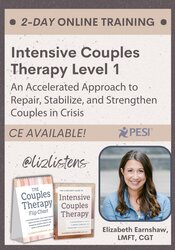
2-Day Intensive Couples Therapy Level 1 Training: An Accelerated Approach to Repair, Stabilize, and Strengthen Couples in Crisis
- Average Rating:
- Not yet rated
- Speaker:
- Elizabeth Earnshaw, LMFT
- Duration:
- 12 Hours
- Format:
- Audio and Video
- Copyright:
-
24 Nov, 2025
- Product Code:
- POS150422
- Media Type:
- Digital Seminar
- Access:
- Never expires.

Description
Traditional 50-minute sessions often limit the progress couples can make—particularly when emotional flooding, conflict cycles, and unfinished conversations stall momentum. Intensive couples therapy offers a longer, uninterrupted format that allows couples to fully engage in deep clinical work, practice regulation skills in real time, and leave with a clearer path forward.
In this training, Elizabeth Earnshaw, LMFT, CGT, will present a structured framework for conducting effective couples intensives. You’ll learn how to determine client fit, set up the logistical and ethical foundations, facilitate change-oriented interventions, and close intensives with a plan for ongoing support.
You will gain practical, applicable skills for:
-
Structuring an intensive: purpose, goals, clinical indications, and contraindications
-
Assessing fit: identifying when intensives are appropriate and when they are not
-
Pre-session preparation: informed consent, scheduling, payment, and consult calls
-
Day One protocols: joining with couples, conducting assessments, and presenting feedback
-
Day Two protocols: facilitating enactments, managing dysregulation, and pacing deep work
-
Ethical decision-making: knowing when to pause or discontinue an intensive
-
Closure and follow-up: planning, referrals, and clinical handoffs
Elizabeth will walk you through four detailed case studies that illustrate common presentations, intervention strategies, and outcomes:
-
Alex & Priya – Chronic low-grade conflict and existential drift
-
Marcus & Dani – Post-baby relational strain and resentment
-
Linda & Charles – Later-life relationship under stress
-
Jordan & Ray – Coupleship in recovery under threat
These examples will show how assessment, intervention selection, enactment facilitation, and regulation skills unfold across the two-day intensive format.
CPD
Speaker

Elizabeth Earnshaw, LMFT Related seminars and products
Elizabeth Earnshaw, LMFT, is a Marriage and Family Therapist, Clinical Fellow of the American Association of Marriage and Family Therapy (AAMFT), Certified Gottman Method Couples Therapist, Certified Clinical Trauma Professional, and AAMFT Approved Supervisor. She is the author of the best-selling relationship book I Want This to Work, The Couples Therapy Flip Chart, and Til’ Stressed Do Us Part. She is the owner of a national therapy practice that provides systemic therapy to individuals, couples, and families. Elizabeth has worked with hundreds of couples since becoming a couple’s therapist. She lives in West Chester, Pennsylvania, with her husband, children, and dog.
Speaker Disclosures:
Financial: Elizabeth Earnshaw is the founder of Intensive Couples Therapy Institute and A Better Life Therapy, LLC. She receives royalties as a published author. Elizabeth Earnshaw receives a speaking honorarium, recording and book royalties from Psychotherapy Networker and PESI, Inc. She has no relevant financial relationships with ineligible organizations.
Non-financial: Elizabeth Earnshaw is a fellow of AAMFT and a clinical member of Postpartum Support International.
Additional Info
Questions?Visit our FAQ page at www.pesi.com/faq or contact us at www.pesi.com/info
Access for Self-Study (Non-Interactive)
Access never expires for this product.
For a more detailed outline that includes times or durations of time, if needed, please contact cepesi@pesi.com.
Objectives
- Determine the structure, purpose, and clinical indications of intensive couples therapy.
- Appraise client characteristics, presenting problems, and contraindications for participation in intensive couples therapy.
- Determine key logistical and ethical considerations in preparing for intensives, including informed consent, scheduling, and payment.
- Demonstrate how to set clear expectations and create a therapeutic container using consult calls, paperwork, and pre-session communication.
- Utilize strategies for joining with couples through confidence and hope in the first 90 minutes of the intensive.
- Conduct individual and joint assessments during the initial phase of an intensive to gather relevant clinical information.
- Utilize structured feedback processes to present assessment findings and co-create an agenda with the couple.
- Apply enactments to reduce triangulation and facilitate in-session behavioral change between partners.
- Prepare structured exercises (e.g., Speaker/Listener, repair rituals, guided imagery) to deepen emotional connection and insight.
- Demonstrate effective techniques with dysregulated couple interactions,such as cross-tracking, doubling, and physiological soothing.
- Implement closure strategies including The Farewell Conversation, future planning, and clinical handoffs when necessary.
- Evaluate when to pause or discontinue an intensive due to emerging ethical, clinical, or scope-of-practice concerns.
Outline
Couples Intensives: What They Are, Why They Work, Who They Help
- What is intensive couples therapy?
- Purpose, benefits, and risks of longer-format therapy
- Relational dynamics and clinical issues intensives are helpful for
- Contraindications: interpersonal violence, substance use, mixed agendas, suicidality
- Logistical and ethical considerations
- Limitations of the research and potential risks
Setting Up for Success: Training, Policies, Forms, and Communication
- Training, credentials, and characteristics of an intensive couples therapist
- Pre-session communication: policies, paperwork, expectations
- Consultation calls: How to manage client expectations ahead of the session
- Scheduling and payment considerations based on the client
- Assessment: IPV, SI, substance use; modality-based assessments
- Therapist humility: cultural and person-of-the-therapist knowledge
Intensive Day One: Joining, Information Gathering, Preparing and Providing Feedback
- The first 90 minutes
- How to “join through hope” instill a sense of possibility and security early on
- Early enactment: Observing patterns, communication
- Assessment of readiness to change, familial influence, commitment, and goals
- Individual interviews
- Deeper dive into the history of the problem
- Further assessment: Co-morbidities, family of origin issues, disclosures
- Preparing and presenting feedback
- How to share observations effectively
- Creating a “roadmap” for change
- Case studies:
- Alex and Priya: Chronic Low-Grade Conflict, Existential Drift
- Marcus and Dani: Post-Baby Drift and Resentment
- Linda and Charles: Later-Life Love Under Strain
- Jordan and Ray: Recovery Under Threat
Intensive Day Two: Setting Up and Facilitating Enactments, Pacing Deep Work Across Multiple Hours, and Handling Dysregulation in Real Time
- Therapist preparation
- Clinically-informed review of previous day’s feedback sessions
- Choosing the appropriate interventions and exercises
- Prepare to be unprepared: When things don’t go “to plan”
- How to start session with containment and focus
- Enactments: Bringing relational dynamics into the room in real-time
- Successful enactments: Assessment, facilitation, redirecting, and restructuring.
- Choosing exercises to build enactments: Speaker/Listener, the HARD conversations model, guided imagery, the intimacy wheel, repair, negotiation, and more
- Differentiating between “conflict” and “flooding” (diffuse physiological arousal)
- Intervening in dysfunctional patterns to create a new path
- Emotional regulation tools
- Interventions: Stop the Pattern, Map The Dance, commonly used psychoeducation, cross-tracking, doubling, Physiological Self Soothing, and more
- The final hour of the intensive
- Reflection of the shared experience for the couple
- The Farewell Conversation
- Future planning through couple agreements and plans, referrals, and follow up appointments.
- Case study couples revisited: Enactments, exercises, closing practices
Reviews
Satisfaction Guarantee
Your satisfaction is our goal and our guarantee. Concerns should be addressed to info@pesi.co.uk or call 01235847393.
Please wait ...